For families raising children with disabilities, even the smallest breakthrough can feel life changing. A new movement. A new sound. A moment of connection. At May We Help, volunteers use creativity, craftsmanship and compassion to make those moments possible.
For volunteer Paul Henkel, one recent project became a powerful reminder that meaningful solutions do not always have to be large or complicated. Sometimes, a carefully designed small space can open up an entirely new world for a child.
A Volunteer Driven by Problem Solving
Henkel describes himself as being at the end of his “third career.” After graduating from the Naval Academy and serving as an officer for 10 years, he spent 15 years with Fidelity Investments before moving into healthcare operations and quality improvement at Cincinnati Children’s Hospital Medical Center.
For 13 years, his work at Cincinnati Children’s focused on helping teams improve safety, patient outcomes, efficiency and family experience. The work centered around identifying challenges and building better processes to solve them.
That same mindset eventually led him to May We Help.
“I’ve always been interested in projects and solving problems,” Henkel said. “I’m not an engineer, which surprises people. Most of my career was in operations management. But there’s a lot of organization, creativity and problem solving involved in that work.”
Henkel first heard about May We Help through his wife, who works in philanthropy. After attending fundraising events and learning more about the organization’s mission, he finally decided to volunteer about five years ago.
Since then, he has completed roughly 100 projects for individuals and families in need.
“It’s become a true passion for me,” he said. “I’m constantly checking for projects that I think I can help solve.”
Building a “Tiny Room”
One of those projects came through a physical therapist working with a young child who was visually impaired and experiencing multiple disabilities.
The therapist approached May We Help with a unique request: create a small enclosed environment that could help the child better understand and sense the space around them.
The result was what Henkel calls a “tiny room.”
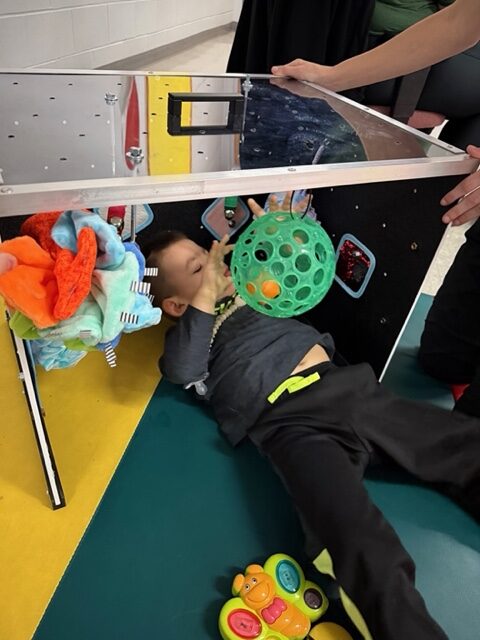
The structure itself is simple in concept, but deeply thoughtful in design. Measuring approximately 18 inches by 18 inches with a width of about 24 inches, the enclosure includes three sides and a top constructed from clear plexiglass. The transparent material allows parents and caregivers to maintain visual contact with the child while creating a more contained sensory environment.
The purpose of the design was to help children with visual impairments develop spatial awareness.
“If you have a child who is visually impaired, particularly when they’re very young, they become much more dependent on hearing and almost a type of echo location,” Henkel explained. “In a normal-sized room, it can be difficult for them to sense boundaries or understand the dimensions around them.”
The tiny room creates those boundaries in a way the child can perceive. Toys suspended from the top provide stimulation and encourage movement, while the enclosed space helps the child recognize that the world around them is not infinite.
Henkel first built a beta version for testing and collaboration with the therapist. Together, they identified improvements before he constructed a final version.
The therapist ultimately asked to keep both.
A Remarkable Moment
When Henkel returned to deliver the completed version several weeks later, the therapist shared something remarkable.
She believed the child had rolled over for the first time because of the tiny room.
The child, she explained, appeared to sense the nearby wall and intentionally moved toward it.
“The therapist was beside herself,” Henkel recalled. “She was convinced the baby now had a sense of space with this tiny room.”
For Henkel, the moment reinforced what makes May We Help so special.
“It doesn’t always require advanced engineering,” he said. “A lot of problems can be solved with ingenuity, creativity and basic shop skills.”
Designed for Real Families
Henkel later created a second tiny room for a school system west of Dayton, refining the design even further. This version included specially selected sensory toys that he researched and ordered specifically for the child who would use it.
As with many May We Help projects, the goal was not simply to build something functional. It was to create something practical, personalized and immediately useful for the families involved.
“I try to make solutions as inexpensive and efficient as possible,” Henkel said. “These families are patient, but if they’re asking for help, they need it.”
That urgency, combined with the compassion and creativity of volunteers, continues to fuel the mission of May We Help every day.
Through projects large and small, volunteers like Henkel are helping individuals with disabilities experience greater independence, confidence and connection to the world around them.